Transform Kidney Care Together:
Discover Resources, Connect your Patients



For Nephrology Practices:
Managing life with kidney disease can be challenging. With the right tools and resources, your patients can live well and continue doing the things that are important to them. We have programs and services to help!
- Patient Services help people with kidney disease better understand and manage their condition, support their families, and access needed resources.
- NKF Peers connects people living with kidney disease, living donors, and care partners with trained mentors who have similar lived experience. Through one-on-one phone support, participants can share experiences and gain encouragement from someone who has been there.
- Kidney Disease Support Group offers people living with kidney disease a welcoming space to share experiences and discuss the challenges and successes of managing kidney disease with others who understand.
For Primary Care Practices:
We’re here to make it easier for you to detect and manage CKD by offering technical assistance and a suite of patient education programs designed to supplement the clinical care your practice or organization provides. How can we help you?
- Assessment of CKD prevalence and underdiagnosis in your patient population
- Technical assistance to increase CKD screening rates and diagnosis. Learn more about our CKD Learning Collaborative model and results.
- Support implementing clinical decision tools into EHR and CKD testing using the uACR and eGFR into your workflows
- Using CKD to identify cardiovascular risk and slow the rising rate of heart disease in the US. Cardiovascular mortality accounts for 40% to 50% of all deaths in patients with advanced CKD.6
- Connect patients to free, evidence-based programs to manage their chronic conditions and lifestyle changes
- Tailored CKD education for your practice
NKFM partnered with an Aspire Rural Health clinic in Cass City to enhance early screening and diagnosis, enabling the detection and management of CKD in its early stages through medications and lifestyle changes, thereby improving patient health outcomes.
Watch Marie’s story:
For Community Health Workers:
CHW’s play a crucial role in addressing both clinical and nonclinical needs of patients, supporting the healthcare team and strengthening relationships and trust within communities. We can equip you with patient tools and resources that can be used to engage, educate, and empower high-risk populations and those already living with kidney disease.
-
-
- To enhance the knowledge and skill base, the NKF offers web-based and customized CHW trainings: NKF CHW training Modules
- In collaboration with MiCHWA, the NKFM has developed a 2-part CKD training for CHWs in Michigan.
- The NKFM’s Finding Your Way Resource Navigation Manuals are helpful tools for CHWs assisting patients with social drivers of health support.
-
For Laboratory Professionals
Laboratory professionals are key to early CKD detection, with lab tests guiding nearly 70% of healthcare decisions making consistent testing and clear reporting essential.
A March 2026 by the NKFM, in partnership with Michigan Department of Health and Human Services (MDHHS), Joint Venture Hospital Laboratories, and Blue Cross Blue Shield of Michigan, examines barriers to CKD testing across Michigan and outlines steps for laboratories to improve practices.
Endorsed by leading Michigan healthcare organizations – Michigan Health & Hospital Association (MHA), Michigan Association of Health Plans (MAHP), Michigan State Medical Society (MSMS) and Michigan Primary Care Association (MPCA).
Here are sample email templates that laboratory professionals can use to notify provider offices of changes made to CKD tests. Labs can fill in dates, contacts and other specific details before distribution:
- For changes to the estimated glomerular filtration rate (eGFR) calculation and reporting
- For changes to uACR terminology
- For changes to both eGFR and uACR
For more information or technical assistance, reach out to healthsystems@nkfm.org.
For Health Plans, Accountable Care or Physician Organizations:
CKD is serious, costly and underdiagnosed. Healthcare costs for adult MI Medicaid beneficiaries with CKD in 2022 was an estimated $3.9 Billion. The NKFM offers guidance to reduce costs by preventing or slowing its progression.
-
-
- Technical assistance to help healthcare organizations improve early detection and strengthen Kidney Health Evaluation for Patients with Diabetes (KED) performance, and advance equity.
- Tailored training on CKD for care managers, CHWs, quality staff, and provider-facing staff
- Data insights on CKD risk factors, disparities, and cost in Michigan through the Kidney Disease Interactive Medicaid Dashboard.
-
- Culturally tailored education materials for members to learn about their risk of kidney disease
-
Refer Your Patient or Member:
Making a healthy lifestyle change can go a long way in preventing or managing your patient’s disease progression.
- Refer your patient or member to one of our evidence-based healthy living programs. We make this easy with our fillable referral form, or use our Provider Portal:
- Directions for Accessing Portal
- Learn more about our Healthy Living Programs
- Check out our Provider Overview sheets:
Clinical Education
2026 Grand Rounds Series
In partnership with Michigan State University College of Osteopathic Medicine, the NKFM is offering a virtual Grand Rounds series in 2026 on Chronic Kidney Disease. Free CME will be provided. Please click on the links below to register for each session:
We offer adaptable clinical education for all healthcare professionals, including medical residents and nursing students – to support excellence in kidney care and clinical practice, including:
- CKD Early Screening and Detection: Learn about CKD risk factors, screening updates, Cardiovascular-Kidney-Metabolic Syndrome (CKM), and quality measures. This helps care teams improve outcomes by using the CKD Heatmap to interpret eGFR and uACR results, focusing on earlier CKD detection and management before nephrology referral.
- Healthy Lifestyles and Nutrition: Led by a Registered Dietitian, learn about lifestyle recommendations for managing chronic disease, including nutritional considerations and the role of medical nutrition therapy to slow or stop kidney disease progression.
- CKD Medication Management: Stay updated on new recommendations for managing CKD medications, reducing kidney damage, and determining the right time to refer patients to nephrology. This opportunity will help providers understand the treatment of CKD at various stages in Primary Care, with clinical education on best practices for managing CKD alongside comorbidities like cardiovascular disease and diabetes.
- Chronic Disease Self-Management Programs: Only 20% of modifiable factors influencing health outcomes can be attributed to interactions within the healthcare environment.7 Learn about the suite of evidence-based patient education programs designed to build positive health behaviors, prevent and/or better manage chronic conditions and empower patients to be active managers of their health.
- Understanding Adverse Childhood Experiences (ACEs): Focused on understanding basic brain development in relation to ACEs, increasing knowledge of the ACE study and its findings, identifying the link between ACEs adult illness and chronic disease, and an introduction on ways to build resilient and self-healing communities.
- Healthy Outcomes from Positive Experiences (HOPE): NKFM provides education that focuses on HOPE. A framework that teaches the key positive childhood experiences that help children grow into healthy, resilient adults and how our communities and systems of care can provide access to them.
Results
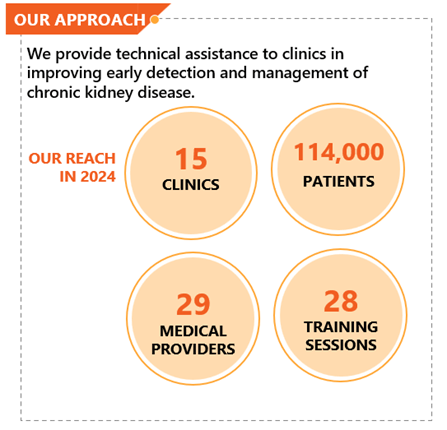
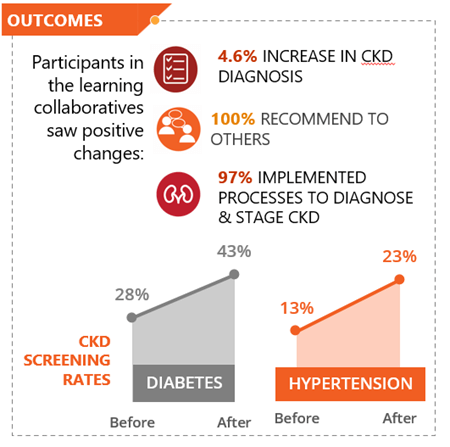
Learn more about our model and results: Building Bridges Lessons Learned from CKD LC
Feedback from NKFM’s Clinical Partners:
“Clinical training in the early detection of chronic kidney disease through the National Kidney Foundation of Michigan at Authority Health’s Popoff Family Health Center has enhanced our ability to prevent the secondary effects of the disease and provide a better quality of life for our patients. The NKFM staff has designed the training with a thorough understanding of our organization’s community health mission. This collaboration has been instrumental in guiding our primary care team in building the capacity to improve our primary care services.”
– Dr. Prashanti Boinapally, Director of Programs & Quality, Authority Health.
“The National Kidney Foundation of Michigan has been an excellent partner to collaborate with to promote kidney health and best practices. They have assisted us in many ways, including joining us to educate providers so they can better serve our members.”
– Michigan Medicaid Health Plan
For more information or to explore a partnership, please contact the Health Systems Interventions Team.
References
- Chronic kidney disease in the United States, 2023. Centers for Disease Control and Prevention. https://www.cdc.gov/kidney-disease/php/data-research/index.html
- Kidney Disease Statistics for the United States – NIDDK
- Alfego, D., Ennis, J., Gillespie, B., Lewis, M. J., Montgomery, E., Ferrè, S., Vassalotti, J. A., & Letovsky, S. (2021). Chronic kidney disease testing among at-risk adults in the U.S. remains low: Real-world evidence from a national laboratory database. Diabetes Care, 44(9), 2025–2032. https://pmc.ncbi.nlm.nih.gov/articles/PMC8740927/#B22
- Chronic Kidney Disease Basics | Chronic Kidney Disease | CDC
- Chronic kidney disease. SOM – State of Michigan. https://www.michigan.gov/mdhhs/keep-mi-healthy/chronicdiseases/diabetes/chronic-kidney-disease
- Thompson, S., James, M., Wiebe, N., Hemmelgarn, B., Manns, B., Klarenbach, S., & Tonelli, M. (2015). Cause of death in patients with reduced kidney function. Journal of the American Society of Nephrology, 26(10), 2504–2511. https://journals.lww.com/jasn/abstract/2015/10000/cause_of_death_in_patients_with_reduced_kidney.23.aspx
- Hood, C. M., Gennuso, K. P., Swain, G. R., & Catlin, B. B. (2016). County Health Rankings: Relationship Between Determinant Factors and Health Outcomes. American Journal of Preventive Medicine, 50(2), 129–135. https://doi.org/10.1016/j.amepre.2015.08.024